

12th December 2025 – spring 2026
The notion of discontinuity, by definition, accepts the moment of pause as part of the whole.
With its character of a ruin of a forgotten purpose the unfinished building is at the same time pointing to the past and to the future, as a frozen moment of time preserved ever since its volume reached that concrete state . The architectural archetype of the unfinished concrete building can be encountered everywhere in the cityscape of Athens ...and speaking of Athenian chronicles, it is impossible not to see them.
Unfinished buildings are a dynamic phenomenon. Those structures, left in the middle of a discontinued building process in a seemingly never-ending pause, are closely linked to the history of the construction of modern Athens. The theme of the exhibition Discontinuity as Chronicle is underlining the pause as a valid element in what otherwise appears as constant evolution. As a lacuna in production, and at the same time as a bearer of memory and history.
The project initially started as a simple registration of the unfinished structures in the cityscape. However, it quickly evolved into an extensive investigation of the phenomenon in an attempt to both understand and not undermine the concealed profiles of the buildings, allowing the uncovering of strategies, systems and social conventions applied through modernity to the city of Athens and its inhabitants. Our methodology can be considered as a type of contemporary archaeology. Collecting, recording and analysing bits of historical data has involved countless days of research in the poleodomia archives, endless kilometres of walked streets, and hours of interviews with involved parties; when assembled, these pieces form a chronicle of the silenced yet significant paused moments of modernity.
Discontinuity as Chronicle has as its central protagonist the concrete skeletons of the Athenian Metropolis, illuminated through the visual/research work [UN]FINISHED by Maria Lalou & Skafte Aymo-Boot. The project is an extensive investigation of the phenomenon involving bureaucracy, authorities at different levels, knowledge extraction, research methods, recording systems, social models and poignant dialogues, culminating in the publication of the book [UN]FINISHED - Atlas of Athens' Incomplete Buildings - A Story of Hidden Antimonuments (2023, Jap Sam Books).
The exhibition proposes a reflective reading of the pause, extracted from the realities of Athenian everyday lives, with as overall material the archive of the ten-year research on the unfinished skeletons in the seven districts of Athens, and with the book as a guiding structure. Discontinuity as Chronicle approaches the condition of the unfinished from a multitude of perspectives, unfolding in three chapters and a prologue at three locations in central Athens from December 2025 till March 2026:
With the support of The J.F. Costopoulos Foundation

12th - 13th December 2025
Join us for the Prologue of Discontinuity as Chronicle, starting the exhibition period with a lecture performance by Lalou & Aymo-Boot, the screening of the video The Barbaresou Legacy, Or The Cursed One, and the video installation Closing the Archive, introduction and after talk with Thalia Raftopoulou.
Location: Circuits and Currents, 13, Notara & Tositsa Str.
Lecture performance and screening: Friday 12th December 20:00 -21:30.
Video installation: Saturday 13th December 15:00 -22:00.
14th November 2024 – 8th March 2025
The first chapter of cross section archive's 2024-25 thematic Post-Human Archaeology is a series of five solo presentations that together form the exhibition Reconstructing Memories. With an archaeology that is non-canonical and open-ended as method, it is playing with the perceived authority of the expert and allows for the dissection of a subject with an intuitive and personal approach. Reconstructing Memories invites the viewer to question not only the work and its staged contents, but also their own perception of reality.
Composed of five communed installations developed specially for the program, Reconstructing Memories is approaching the theme from five different departure points. On History, by visual artist Vangelis Vlahos (GR) is re-creating a forgotten but significant event that no-one witnessed. On Media by Rabih Mroué (LB), confronts the perspective of the viewers and the media as a tool of control over history’s performance. On Politics, by the artist/architects collective [Pegy Zali, Panayotis Lianos, Christos-G. Kritikos] (GR), narrating the story of a void observed through the filter of a politicised media reality and marked by a displaced urban object. On Nature by visual artist Nikos Arvanitis (GR) is excavating the collective urban mind to uncover traces of nature. On Language by visual artist Nicoline van Harskamp (NL) creates a performative embodiment of our programmed communication.
The works will be displayed in the space of cross section archive one by one from November 2024 till March 2025, each for a period of two weeks and each marked by an opening event. Following our selected exhibition principle, the works will be on view from the public space of the crossing of Mavromichali and Isavron. The whole exhibition period of Reconstructing Memories will be concluded with a closing event along with the launch of a catalogue pamphlet, designed by Studio Lialios Vazoura, bringing the five works together in one volume as the collective dialogue chapter of Post-Human Archaeology.
The overall program of Post-Human Archaeology and Reconstructing Memories at cross section archive in Athens is curated by conceptual artist and experimental filmmaker Maria Lalou and architect Skafte Aymo-Boot.
Reconstructing Memories is realised with financial support and under the auspices of the Hellenic Ministry of Culture.


20th February - 8th March 2025
entry to the space daily 19:00 – 22:00
We are pleased to welcome you to the live performance and opening of the exhibition Café Prosodia by visual artist Nicoline van Harskamp (NL) at cross section archive in Athens. Café Prosodia is the 5th and last chapter of Reconstructing Memories, ’On Language’.
Two humans, seated in a small coffee house installed in the space of cross section archive, and one neural network named Prosodia, who changes voices in every scene, play the same dialogue repeatedly in various acting styles. Café Prosodia speculates on the ways in which the technology of synthetic speech is rooted in the technology of acting, proposing a future form of ‘machine talk’, informed by the rhythmic, additive structures of human storytelling.
Café Prosodia opens its doors with a live performance by Angeliki Papoulia and Sofia Kokkali with Prosodia. A limited number of people can enter Café Prosodia with a reservation for a time slot. Entrance is free. Audience without a reservation can watch the live performance from the public space of the crossing of Isavron and Mavromichali streets.
Café Prosodia surveys the prosody – intonation, pitch, timbre, etc - of machine-generated speech. Synthetic voices are trained with datasets of screen acting and lecture-like speech, and thus generate their own prosody based on this. Like the machine-generation of speech, acting is a technology that operates through scripting and instruction, and tends to reveal itself as a technology through flawed prosodic output. The work excavates these foundational parts of both technologies, in an attempt to generate an alterative speech phenomenon.
Artificial intelligence is often visualized as a non-linear and non-chronological. It is however, the outcome of long collective processes, passed-on knowledge about nature, craft, technology and also language. When someone reads a text, their own voice is taken over by the voices of others - both that of the author and that of all the people who helped shape the language and its rhythmic forms. The synthetic voice is in many ways an ancient voice, even all voices that have ever existed.
‘Café Prosodia' by Nicoline van Harskamp.
Curated by Maria Lalou and Skafte Aymo-Boot.
Actors: Angeliki Papoulia, Sofia Kokkali.
Cinematography, camera: Dimitris Christodoulou.
Sound: Nikos Patelaros.
Photography: Pinelopi Gerasimou.
Production, casting, staging: cross section archive.
Development and coding: Alex Sutherland and SynGen AI Technologies AB.
Voice technology: Elevenlabs.io.
Research made possible by: Creative Industries Fund and Pauwhof Fund, Netherlands.
Thanks to: Cachou restaurant Athens, Thomas Haubner at Kunstakademie Münster, Yiannis Malatantis, Andriana Plessa.
Special thanks to: Victor Martens and Constant van Harskamp.
Exhibition duration: 20th January - 15th February 2025.
Café Prosodia can be accessed daily, 19:00 - 22:00, using the seats of the café for a viewing. A short scene with Prosodia is accessible from the public space of Isavron street, with a QR code leading to a personal dialogue with Prosodia.
Reconstructing Memories is supported by and under the auspices of the Hellenic Ministry of Culture.
The production of Café Prosodia is made possible with financial support from the Mondriaan Fund.

30th January - 15th February 2025
daily 18:00 – 24:00
We are pleased to welcome you to the opening of the exhibition a perfect world by visual artist Nikos Arvanitis (GR) at cross section archive in Athens. The exhibition presents a new work developed specifically for Reconstructing Memories, and forms the fourth chapter ’On Nature’.
Starting from an excavation of the collective urban mind a perfect world is seeking to uncover relations between the contemporary human being and nature. Firmly removed from any actual nature, the work attempts to raise questions concerning the anthropocentric position, creating a ‘natural’ world that is completely artificial.
A perfect world addresses an existential crisis in the relationship between human and nature. The work unfolds as a fictional narrative 1 enhanced with sound compositions based on studio recordings in which city residents were invited, using their voices, to imitate - faithfully, idiosyncratically or stereotypically - sounds of flora, fauna, natural elements and phenomena as well as other sound events, mimicking the sounds of the natural environment.
Nature exists merely as a mental image, as a controlled piece of design. Nothing in the work is real: Two anthropomorphic animals are having a philosophical discussion about how to mould their environment into an ideal shape, while a perfectly crafted artificial rock hovers centrally in the installation. Even if at first perceived as authentic, the soundscape gradually reveals itself, underlining different degrees of connectedness in the urban humans’ perceptions of nature. Artificial nature or naturally artificial, humanoid nature or naturally human. The elements of the work seek to find a position in this troublesome relationship at the same time as pointing out that the polarity itself is just a construction of the human intellect.
1 Based on the children's book “Rabbit and Bear: The Perfect World of Rabbit” by Julian Gough and Jim Field, Icarus Publishing, 2024 and the film Der Rechte Weg (The right way) by Peter Fischli and David Weiss, 1982-1983.
‘a perfect world' by Nikos Arvanitis.
Curated by Maria Lalou and Skafte Aymo-Boot.
Wood, styrofoam, resin mortar, acrylic paints, pigments, varnish, video, sound, dimensions variable, duration 23' 08''.
With the voices of: Elli Arvaniti, Nikos Arvanitis, Giorgos Asimakakis, Eleni Chalavazi, Natasa Kopsaftopoulou, Andrianna Panagiotaki, Aggeliki Soupiona, Apostolos Tsorfolias, Xenofon Vardaros, Despoina Vaxevanidi, Christos Zafeiris, Maria Zervoudaki and Magdalena Zotou.
Technical advisor: Apostolos Polychroniadis.
Exhibition duration: 30th January - 15th February 2025.
The exhibition is on view daily 18.00 - 24.00 from the public space of the crossing between Mavromichali and Isavron streets.
Reconstructing Memories is supported by and under the auspices of the Hellenic Ministry of Culture.

9th - 25th January 2025
daily 18:00 – 24:00
‘Disengagement Rehearsals' by [Pegy Zali, Panayotis Lianos, Christos-G. Kritikos].
Curated by Maria Lalou and Skafte Aymo-Boot.
Video on monitor, video projection on wall, A3 prints glued on window, sound, table with sound equipment, chairs.
Special thanks to: Christoforos Loupas, Meri Zali, Bobby Black, Achilleas Papakonstantinou, G.V.V.
Exhibition duration: 9th - 25th January 2025.
The exhibition is on view daily 18.00 - 24.00 from the public space of the crossing between Mavromichali and Isavron streets.
Reconstructing Memories is supported by and under the auspices of the Hellenic Ministry of Culture.
5th - 21st December 2024
entry to the space daily, one person at a time, 18:00 - 21:00
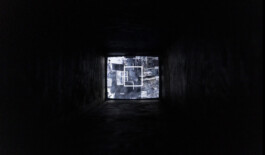
We are pleased to present the exhibition The negotiation of perspective, by Rabih Mroué (LB) at cross section archive in Athens. The site specific exhibition and installation is developed for Reconstructing Memories, and forms the second chapter ’On Media’.
The installation The negotiation of perspective, is shaking the safe zone of ‘an observer of a witness’, with the spectator becoming a ‘stand in’ in the timeline of the events, in a choreographed embodiment of the power of an image.
An ensemble of video works by Rabih Mroué invites the spectator to take a position of a multitude of viewing. Only one person at a time can enter the usually inaccessible space of cross section archive to experience the works. The exhibition The negotiation of perspective is a one-off personal visual registration of the human eye.
Rabih Mroué stages an alignment of perspectives, attempting an embodiment of a personal coordinate system of x, y, z and its signature on current history. The power of the gaze vs the control of the curated image projected on the retina has become a strategical tool for media authority over certain predefined narratives, significantly reinforcing the disorienting effect of the media. The controlled status of an image vs the shaken stability of a timeline points to the media as a dictating instrument of the articulation of history. An onlooker, a viewer, an observer, a spectator? Wordings of chosen potential perspectives on the motives behind this power of image control.
‘The negotiation of perspective' by Rabih Mroué.
Curated by Maria Lalou and Skafte Aymo-Boot.
Produced by cross section archive.
3 video loops in viewing boxes, variable dimensions; video 6m 48s on monitor, in loop.
Special thanks to: Lina Majdalanie and Sarmad Louis.
Exhibition duration: 5th - 21st December 2024.
The exhibition is open daily.
Entry to the space for the 3 viewing boxes, one person at a time, 18:00 - 21:00.
One video is on view from the public space of Isavron street.
Reconstructing Memories is supported by and under the auspices of the Hellenic Ministry of Culture.

14th - 30th November 2024
daily 17:00 – 24:00
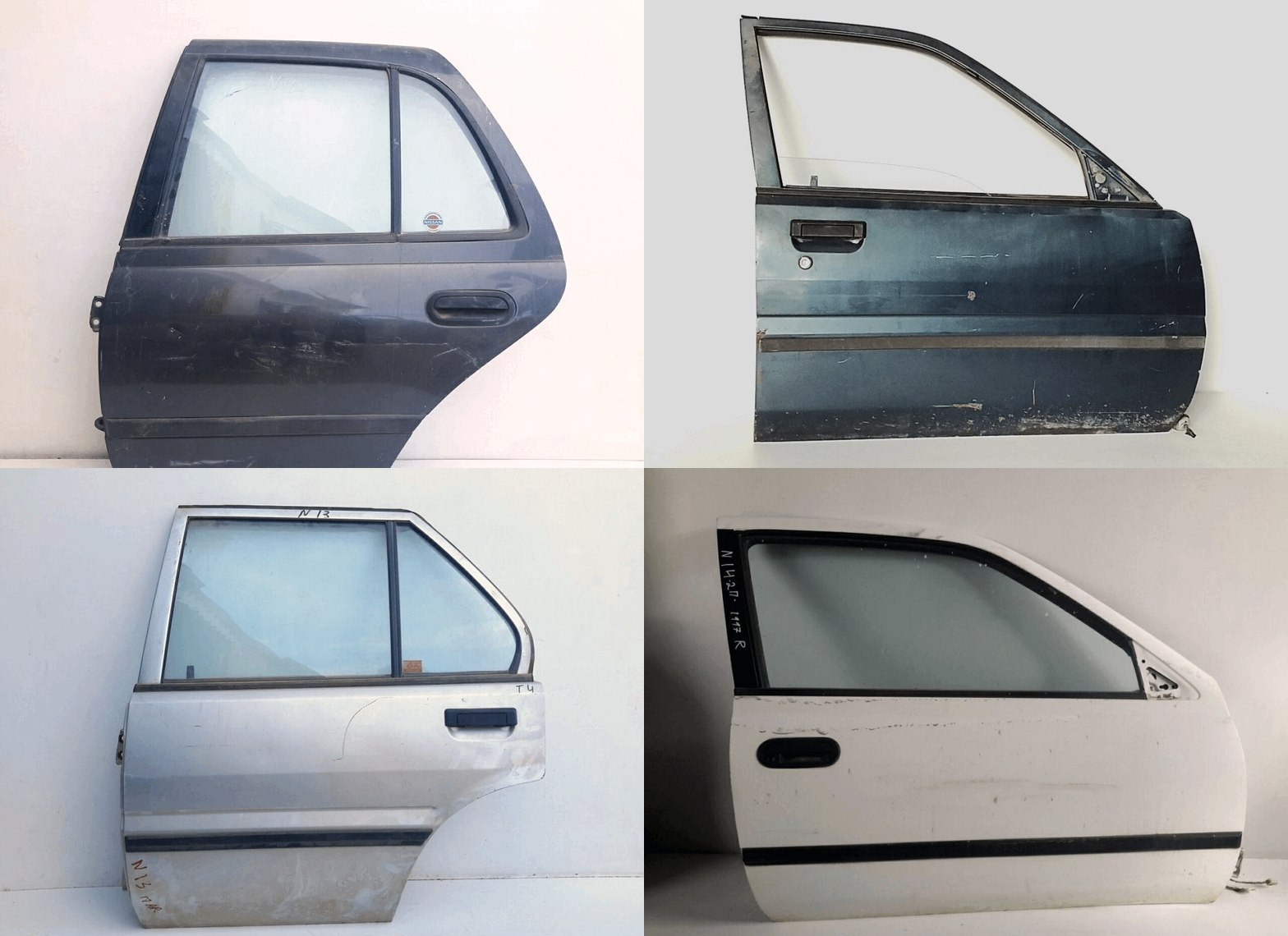
cross section archive is pleased to present the exhibition and premiere of the new work This event has now ended (Nissan Sunny) by Vangelis Vlahos (GR).
Vangelis Vlahos’ filmic gesture is negotiating certain co-ordinates of the roles of time and memory, meticulously re-creating an event from Athens’ current past which may not quite have found a place in the communal memory of the city.
On April 10, 2014, after two warning calls, a bomb planted inside a stolen Nissan Sunny exploded outside the Bank of Greece in downtown Athens. The project revisits this event by utilizing publicly available audiovisual material from the explosion site, including CCTV footage and videos from live news broadcasts. It omits the sound of the explosion, focusing instead on minor, seemingly insignificant sounds not directly related to the event, such as a nose blowing, a phone vibrating, a car door closing, or a lighter clicking. These sound observations are recorded chronologically as they occur, composing a timeline in text form. This event has now ended (Nissan Sunny) presents 182 sound descriptions as closed captions at the bottom of the screen in a nearly seven-hour-long video, fully synchronised with the exact moments when the sounds are heard at the explosion site and during the live broadcasts.
In the subtle but dynamic work by Vangelis Vlahos, a merging of roles takes place between the author and the spectator. A description becomes an instruction, choreographing a position in our indirect witnessing of an event that no-one witnessed. The installation of This event has now ended (Nissan Sunny) at cross section archive is a negotiation of time and its registration, an experience of witnessing an echo of an event, portraying the author as an observer second per second as another witness, and the viewer of the work as an activated spectator of both the event and the work itself.
A limited edition print has been produced specifically for the exhibition, numbered and signed by Vangelis Vlahos.
order it here
‘This event has now ended (Nissan Sunny)' by Vangelis Vlahos.
Curated by Maria Lalou & Skafte Aymo-Boot.
Video 6h 52m on monitor, video loop on tablet, text on A4 paper mounted on window, poster 64 x 86 cm mounted on window, table and lamp.
Special thanks to: Studio Lialios Vazoura.
Exhibition duration: 14th - 30th November 2024.
The exhibition is on view daily 17.00 - 24.00 from the public space of the crossing between Mavromichali and Isavron streets.
Reconstructing Memories is supported by the Hellenic Ministry of Culture.


Memory per se, as a projection, imprint, and record, constitutes an active fabric of both our subconsciously evolving reality and our experiential evolution. But it is also, as an emancipated concept, an objective record of our history, as a situational institution, generally systematized by the media and rejecting the subjectivity of memory. Giorgio Agamben claims that "there cannot be a subject of pure experience, because imagination and fantasy have long been excluded from knowledge as unreal." He continues that "experience today is mediated and performed outside the individual.” 1
Post-Human Archaeology is the annual theme of cross section archive in 2024-25. It is questioning history and archaeology as practices of truth production. Both fields are delivering a narrative of facts counter to memory; their ground of operation is that of constructed memories. The archaeologist is piecing together meaningful narratives through assumptions and theories brought about by fragments of objects or other traces of human activity with the goal of establishing explanations and truths. Those truths are by definition unstable and flexible as they are defined or coloured by the understanding of the world of the ones who are suggesting them, and the disposition of the times they are living in.
Post-Human Archaeology is an attempt to produce alternative understandings of early 21st century life and the truths it frames by applying a gaze with an origin outside of ourselves, a beyond-human gaze so to speak. A gaze that is not looking directly at the object of interest but rather at a version of reality that is out of focus or incomplete. In this processed reality we can expect to make finds that expand our understanding towards our being and the way we perceive ourselves.
With Post-Human Archaeology, cross section archive wishes to challenge the idea of how valid perceptions of the city and the immediate past are based on a combination of some selected facts. The expansion of the term will be explored in a three-part programme, a formula drawn from previous thematics, starting with the communal discourse Reconstructing Memories, continuing with the publication of Document #3 and ending with a commissioned solo exhibition.
The annual thematics of cross section archive are curated and organised by Maria Lalou and Skafte Aymo-Boot.
1 Agamben, G. Infancy and History: On the Destruction of Experience (tr. Heron, L.), 1993 Verso Books
12th December 2025 – spring 2026
The notion of discontinuity, by definition, accepts the moment of pause as part of the whole.
With its character of a ruin of a forgotten purpose the unfinished building is at the same time pointing to the past and to the future, as a frozen moment of time preserved ever since its volume reached that concrete state . The architectural archetype of the unfinished concrete building can be encountered everywhere in the cityscape of Athens ...and speaking of Athenian chronicles, it is impossible not to see them.
Unfinished buildings are a dynamic phenomenon. Those structures, left in the middle of a discontinued building process in a seemingly never-ending pause, are closely linked to the history of the construction of modern Athens. The theme of the exhibition Discontinuity as Chronicle is underlining the pause as a valid element in what otherwise appears as constant evolution. As a lacuna in production, and at the same time as a bearer of memory and history.
The project initially started as a simple registration of the unfinished structures in the cityscape. However, it quickly evolved into an extensive investigation of the phenomenon in an attempt to both understand and not undermine the concealed profiles of the buildings, allowing the uncovering of strategies, systems and social conventions applied through modernity to the city of Athens and its inhabitants. Our methodology can be considered as a type of contemporary archaeology. Collecting, recording and analysing bits of historical data has involved countless days of research in the poleodomia archives, endless kilometres of walked streets, and hours of interviews with involved parties; when assembled, these pieces form a chronicle of the silenced yet significant paused moments of modernity.
Discontinuity as Chronicle has as its central protagonist the concrete skeletons of the Athenian Metropolis, illuminated through the visual/research work [UN]FINISHED by Maria Lalou & Skafte Aymo-Boot. The project is an extensive investigation of the phenomenon involving bureaucracy, authorities at different levels, knowledge extraction, research methods, recording systems, social models and poignant dialogues, culminating in the publication of the book [UN]FINISHED - Atlas of the Unfinished Buildings of Athens - A Story of Hidden Antimonuments (2023, Jap Sam Books).
The exhibition proposes a reflective reading of the pause, extracted from the realities of Athenian everyday lives, with as overall material the archive of the ten-year research on the unfinished skeletons in the seven districts of Athens, and with the book as a guiding structure. Discontinuity as Chronicle approaches the condition of the unfinished from a multitude of perspectives, unfolding in three chapters and a prologue at three locations in central Athens from December 2025 till March 2026:
12th - 13th December 2025
Join us for the Prologue of Discontinuity as Chronicle, starting the exhibition period with a lecture performance by Lalou & Aymo-Boot, the screening of the video The Barbaresou Legacy, Or The Cursed One, and the video installation Closing the Archive, introduction and after talk with Thalia Raftopoulou.
Location: Circuits and Currents, 13, Notara & Tositsa Str.
Lecture performance and screening: Friday 12th December 20:00 -21:30.
Video installation: Saturday 13th December 15:00 -22:00.
14th November 2024 – 8th March 2025
The first chapter of cross section archive's 2024-25 thematic Post-Human Archaeology is a series of five solo presentations that together form the exhibition Reconstructing Memories. With an archaeology that is non-canonical and open-ended as method, it is playing with the perceived authority of the expert and allows for the dissection of a subject with an intuitive and personal approach. Reconstructing Memories invites the viewer to question not only the work and its staged contents, but also their own perception of reality.
Composed of five communed installations developed specially for the program, Reconstructing Memories is approaching the theme from five different departure points. On History, by visual artist Vangelis Vlahos (GR) is re-creating a forgotten but significant event that no-one witnessed. On Media by Rabih Mroué (LB), confronts the perspective of the viewers and the media as a tool of control over history’s performance. On Politics, by the artist/architects collective [Pegy Zali, Panayotis Lianos, Christos-G. Kritikos] (GR), narrating the story of a void observed through the filter of a politicised media reality and marked by a displaced urban object. On Nature by visual artist Nikos Arvanitis (GR) is excavating the collective urban mind to uncover traces of nature. On Language by visual artist Nicoline van Harskamp (NL) creates a performative embodiment of our programmed communication.
The works will be displayed in the space of cross section archive one by one from November 2024 till March 2025, each for a period of two weeks and each marked by an opening event. Following our selected exhibition principle, the works will be on view from the public space of the crossing of Mavromichali and Isavron. The whole exhibition period of Reconstructing Memories will be concluded with a closing event along with the launch of a catalogue pamphlet, designed by Studio Lialios Vazoura, bringing the five works together in one volume as the collective dialogue chapter of Post-Human Archaeology.
The overall program of Post-Human Archaeology and Reconstructing Memories at cross section archive in Athens is curated by conceptual artist and experimental filmmaker Maria Lalou and architect Skafte Aymo-Boot.
Reconstructing Memories is realised with financial support and under the auspices of the Hellenic Ministry of Culture.
20th February - 8th March 2025
entry to the space daily 19:00 – 22:00
We are pleased to welcome you to the live performance and opening of the exhibition Café Prosodia by visual artist Nicoline van Harskamp (NL) at cross section archive in Athens. Café Prosodia is the 5th and last chapter of Reconstructing Memories, ’On Language’.
Two humans, seated in a small coffee house installed in the space of cross section archive, and one neural network named Prosodia, who changes voices in every scene, play the same dialogue repeatedly in various acting styles. Café Prosodia speculates on the ways in which the technology of synthetic speech is rooted in the technology of acting, proposing a future form of ‘machine talk’, informed by the rhythmic, additive structures of human storytelling.
Café Prosodia opens its doors with a live performance by Angeliki Papoulia and Sofia Kokkali with Prosodia. A limited number of people can enter Café Prosodia with a reservation for a time slot here. Entrance is free. Audience without a reservation can watch the live performance from the public space of the crossing of Isavron and Mavromichali streets.
Café Prosodia surveys the prosody – intonation, pitch, timbre, etc - of machine-generated speech. Synthetic voices are trained with datasets of screen acting and lecture-like speech, and thus generate their own prosody based on this. Like the machine-generation of speech, acting is a technology that operates through scripting and instruction, and tends to reveal itself as a technology through flawed prosodic output. The work excavates these foundational parts of both technologies, in an attempt to generate an alterative speech phenomenon.
Artificial intelligence is often visualized as a non-linear and non-chronological. It is however, the outcome of long collective processes, passed-on knowledge about nature, craft, technology and also language. When someone reads a text, their own voice is taken over by the voices of others - both that of the author and that of all the people who helped shape the language and its rhythmic forms. The synthetic voice is in many ways an ancient voice, even all voices that have ever existed.
‘Café Prosodia' by Nicoline van Harskamp.
Curated by Maria Lalou and Skafte Aymo-Boot.
Actors: Angeliki Papoulia, Sofia Kokkali.
Production, casting, staging: cross section archive.
Development and coding: Alex Sutherland and SynGen AI Technologies AB.
Voice technology: Elevenlabs.io.
Research made possible by: Creative Industries Fund and Pauwhof Fund, Netherlands.
Thanks to: Cachou restaurant Athens, printing Thomas Haubner at Kunstakademie Münster.
Special thanks to: Victor Martens and Constant van Harskamp.
Exhibition duration: 20th February - 8th March 2025.
Café Prosodia can be accessed daily, 19:00 - 22:00, using the seats of the café for a viewing. A short scene with Prosodia is accessible from the public space of Isavron street, with a QR code leading to a personal dialogue with Prosodia.
Reconstructing Memories is supported by and under the auspices of the Hellenic Ministry of Culture.
The production of Café Prosodia is supported by the Mondriaan Fund.
30th January - 15th February 2025
daily 18:00 – 24:00
We are pleased to present the exhibition a perfect world by visual artist Nikos Arvanitis (GR) at cross section archive in Athens. The exhibition presents a new work developed specifically for Reconstructing Memories, and forms the fourth chapter ’On Nature’.
Starting from an excavation of the collective urban mind a perfect world is seeking to uncover relations between the contemporary human being and nature. Firmly removed from any actual nature, the work attempts to raise questions concerning the anthropocentric position, creating a ‘natural’ world that is completely artificial.
A perfect world addresses an existential crisis in the relationship between human and nature. The work unfolds as a fictional narrative 1 enhanced with sound compositions based on studio recordings in which city residents were invited, using their voices, to imitate - faithfully, idiosyncratically or stereotypically - sounds of flora, fauna, natural elements and phenomena as well as other sound events, mimicking the sounds of the natural environment.
Nature exists merely as a mental image, as a controlled piece of design. Nothing in the work is real: Two anthropomorphic animals are having a philosophical discussion about how to mould their environment into an ideal shape, while a perfectly crafted artificial rock hovers centrally in the installation. Even if at first perceived as authentic, the soundscape gradually reveals itself, underlining different degrees of connectedness in the urban humans’ perceptions of nature. Artificial nature or naturally artificial, humanoid nature or naturally human. The elements of the work seek to find a position in this troublesome relationship at the same time as pointing out that the polarity itself is just a construction of the human intellect.
‘a perfect world' by Nikos Arvanitis.
Curated by Maria Lalou and Skafte Aymo-Boot.
Wood, styrofoam, resin mortar, acrylic paints, pigments, varnish, video, sound, dimensions variable, duration 23' 08''.
With the voices of: Elli Arvaniti, Nikos Arvanitis, Giorgos Asimakakis, Eleni Chalavazi, Natasa Kopsaftopoulou, Andrianna Panagiotaki, Aggeliki Soupiona, Apostolos Tsorfolias, Xenofon Vardaros, Despoina Vaxevanidi, Christos Zafeiris, Maria Zervoudaki and Magdalena Zotou.
Technical advisor: Apostolos Polychroniadis.
Exhibition duration: 20th January - 15th February 2025.
The exhibition is on view daily 18.00 - 24.00 from the public space of the crossing between Mavromichali and Isavron streets.
Reconstructing Memories is supported by and under the auspices of the Hellenic Ministry of Culture.
9th - 25th January 2025
daily 18:00 – 24:00
‘Disengagement Rehearsals' by [Pegy Zali, Panayotis Lianos, Christos-G. Kritikos].
Curated by Maria Lalou and Skafte Aymo-Boot.
Video on monitor, video projection on wall, A3 prints glued on window, sound, table with sound equipment, chairs.
Special thanks to: Christoforos Loupas, Meri Zali, Bobby Black, Achilleas Papakonstantinou, G.V.V.
Exhibition duration: 9th - 25th January 2025.
The exhibition is on view daily 18.00 - 24.00 from the public space of the crossing between Mavromichali and Isavron streets.
Reconstructing Memories is supported by and under the auspices of the Hellenic Ministry of Culture.
5th - 21st December 2024
entry to the space daily, one person at a time, 18:00 - 21:00
We are pleased to present the exhibition The negotiation of perspective, by Rabih Mroué (LB) at cross section archive in Athens. The site specific exhibition and installation is developed for Reconstructing Memories, and forms the second chapter ’On Media’.
Rabih Mroué stages an alignment of perspectives, attempting an embodiment of a personal coordinate system of x, y, z and its signature on current history. The power of the gaze vs the control of the curated image projected on the retina has become a strategical tool for media authority over certain predefined narratives, significantly reinforcing the disorienting effect of the media. The controlled status of an image vs the shaken stability of a timeline points to the media as a dictating instrument of the articulation of history. An onlooker, a viewer, an observer, a spectator? Wordings of chosen potential perspectives on the motives behind this power of image control.
The installation The negotiation of perspective, is shaking the safe zone of ‘an observer of a witness’, with the spectator becoming a ‘stand in’ in the timeline of the events, in a choreographed embodiment of the power of an image.
An ensemble of video works by Rabih Mroué invites the spectator to take a position of a multitude of viewing. Only one person at a time can enter the usually inaccessible space of cross section archive to experience the works. The exhibition The negotiation of perspective is a one-off personal visual registration of the human eye.
‘The negotiation of perspective' by Rabih Mroué.
Curated by Maria Lalou and Skafte Aymo-Boot.
Produced by cross section archive.
3 video loops in viewing boxes, variable dimensions; video 6m 48s on monitor, in loop.
Special thanks to: Lina Majdalanie and Sarmad Louis.
Exhibition duration: 5th - 21st December 2024.
The exhibition is open daily.
Entry to the space for the 3 viewing boxes, one person at a time, 18:00 - 21:00.
One video is on view from the public space of Isavron street.
Reconstructing Memories is supported by and under the auspices of the Hellenic Ministry of Culture.
14th - 30th November 2024
daily 17:00 – 24:00
cross section archive is pleased to present the exhibition and premiere of the new work This event has now ended (Nissan Sunny) by Vangelis Vlahos (GR).
Vangelis Vlahos’ filmic gesture is negotiating certain co-ordinates of the roles of time and memory, meticulously re-creating an event from Athens’ current past which may not quite have found a place in the communal memory of the city.
On April 10, 2014, after two warning calls, a bomb planted inside a stolen Nissan Sunny exploded outside the Bank of Greece in downtown Athens. The project revisits this event by utilizing publicly available audiovisual material from the explosion site, including CCTV footage and videos from live news broadcasts. It omits the sound of the explosion, focusing instead on minor, seemingly insignificant sounds not directly related to the event, such as a nose blowing, a phone vibrating, a car door closing, or a lighter clicking. These sound observations are recorded chronologically as they occur, composing a timeline in text form. This event has now ended (Nissan Sunny) presents 182 sound descriptions as closed captions at the bottom of the screen in a nearly seven-hour-long video, fully synchronised with the exact moments when the sounds are heard at the explosion site and during the live broadcasts.
In the subtle but dynamic work by Vangelis Vlahos, a merging of roles takes place between the author and the spectator. A description becomes an instruction, choreographing a position in our indirect witnessing of an event that no-one witnessed. The installation of This event has now ended (Nissan Sunny) at cross section archive is a negotiation of time and its registration, an experience of witnessing an echo of an event, portraying the author as an observer second per second as another witness, and the viewer of the work as an activated spectator of both the event and the work itself.
A limited edition print has been produced specifically for the exhibition, numbered and signed by Vangelis Vlahos.
order it here
‘This event has now ended (Nissan Sunny)' by Vangelis Vlahos.
Curated by Maria Lalou & Skafte Aymo-Boot.
Video 6h 52m on monitor, video loop on tablet, text on A4 paper mounted on window, poster 64 x 86 cm mounted on window, table and lamp.
Special thanks to: Studio Lialios Vazoura.
Exhibition duration: 14th - 30th November 2024.
The exhibition is on view daily 17.00 - 24.00 from the public space of the crossing between Mavromichali and Isavron streets.
Reconstructing Memories is supported by the Hellenic Ministry of Culture.
Memory per se, as a projection, imprint, and record, constitutes an active fabric of both our subconsciously evolving reality and our experiential evolution. But it is also, as an emancipated concept, an objective record of our history, as a situational institution, generally systematized by the media and rejecting the subjectivity of memory. Giorgio Agamben claims that "there cannot be a subject of pure experience, because imagination and fantasy have long been excluded from knowledge as unreal." He continues that "experience today is mediated and performed outside the individual.” 1
Post-Human Archaeology is the annual theme of cross section archive in 2024-25. It is questioning history and archaeology as practices of truth production. Both fields are delivering a narrative of facts counter to memory; their ground of operation is that of constructed memories. The archaeologist is piecing together meaningful narratives through assumptions and theories brought about by fragments of objects or other traces of human activity with the goal of establishing explanations and truths. Those truths are by definition unstable and flexible as they are defined or coloured by the understanding of the world of the ones who are suggesting them, and the disposition of the times they are living in.
Post-Human Archaeology is an attempt to produce alternative understandings of early 21st century life and the truths it frames by applying a gaze with an origin outside of ourselves, a beyond-human gaze so to speak. A gaze that is not looking directly at the object of interest but rather at a version of reality that is out of focus or incomplete. In this processed reality we can expect to make finds that expand our understanding towards our being and the way we perceive ourselves.
With Post-Human Archaeology, cross section archive wishes to challenge the idea of how valid perceptions of the city and the immediate past are based on a combination of some selected facts. The expansion of the term will be explored in a three-part programme, a formula drawn from previous thematics, starting with the communal discourse Reconstructing Memories, continuing with the publication of Document #3 and ending with a commissioned solo exhibition.
The annual thematics of cross section archive are curated and organised by Maria Lalou and Skafte Aymo-Boot.
1 Agamben, G. Infancy and History: On the Destruction of Experience (tr. Heron, L.), 1993 Verso Books
